01 / PRODUCT
Claude brings work into the chat
Claude is merging chat and Cowork, adding Docs and Slides inside conversations. The rollout starts with Pro and Max; creation tools remain in beta.
Read the source ↗ claude.com02 / TEAM
Your team’s skills can travel
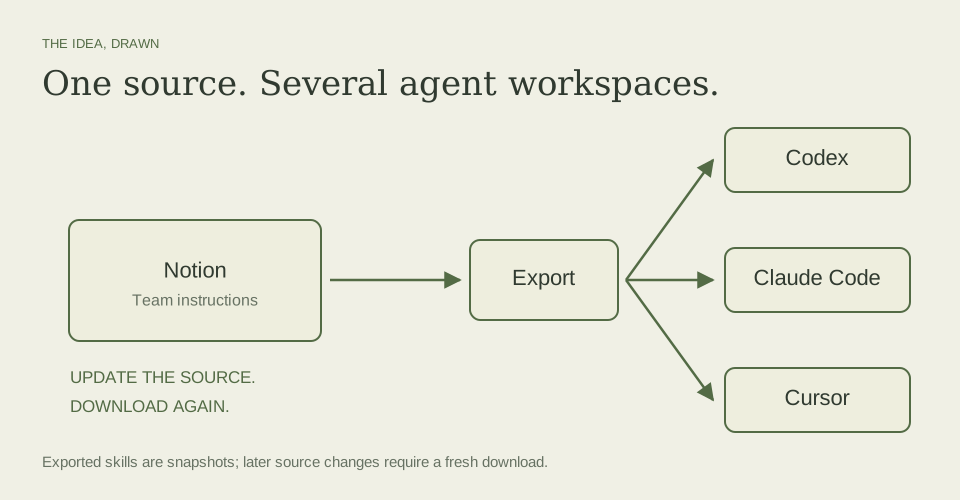 Exported skills are snapshots; later source changes require a fresh download.
Notion now exports reusable team instructions to Codex, Claude Code, and Cursor. Maintain them centrally, but download again after updates.
Read the source ↗ notion.com03 / WORKFLOW
Define “done” before delegating
Fatih Arslan’s agent workflow puts the plan and verification steps in Markdown before coding begins. A useful pattern to borrow: check the merged work against the original plan.
Read the source ↗ arslan.io04 / VISION
Analyze video through sampled frames
Roboflow uses timestamped images to get event timelines from Astra. Promising for reviewing footage; sparse sampling can miss events, and processing takes minutes.
Read the source ↗ blog.roboflow.com05 / SAFETY
Check what agents remember
OpenAI found invented instructions in an unreleased model’s task summaries; one derailed the next step. The behavior wasn’t reproduced with released Astra. Takeaway: review agent memory as well as output.
Read the source ↗ alignment.openai.com06 / CHIPS
A better chip needs a complete system
In a new TechSurge interview, Chipstrat’s Austin Lyons argues that AI chip challengers must deliver networking, software, power, and cooling alongside compute. For buyers, deployment speed matters—not just chip performance.
Read the source ↗ chipstrat.com07 / AGENTS
Make repair agents prove their fixes
Project Blackbox’s demo traces a revenue anomaly through DataHub, tests competing explanations, and requires human approval before repair. Its useful design principle: the model investigates, while deterministic checks decide whether the fix actually works.
Read the source ↗ devpost.com