01 / PERSONAL AGENTS / COMPANY ANNOUNCEMENT
Muse reaches for glasses, but hardware arrives in stages
Meta announced Muse for its AI glasses in the coming months, plus the pocket-sized Muse Charm, with more details promised later this year. Its separate VR Glasses are due in 2027; these are announcements, not products all shipping today.
Read the source ↗ about.fb.com02 / AI FOR SCIENCE / COMPANY RESEARCH
Claude flags an enzyme system whose function remains unknown
Anthropic reports that Claude identified previously uncharacterized features around a known enzyme, revealing an associated repeat-array system. Human scientists performed the lab work. Its biological function remains unknown; the early finding does not establish a new gene-editing tool.
Read the source ↗ www.anthropic.com03 / SOFTWARE / ENGINEERING CASE STUDY
More generated code moves the bottleneck into testing
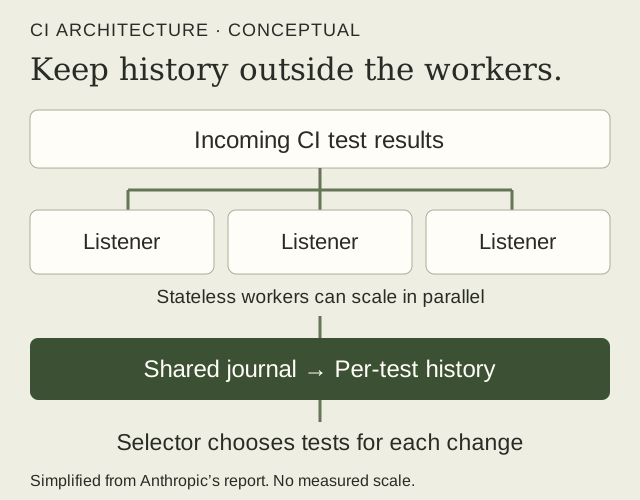 Conceptual illustration of Anthropic’s reported test-selection redesign. A separate consumer rolls the journal into per-test history. The company says this architecture costs more to run but is easier to scale.
In a September 14 engineering account, Anthropic reports a 25-fold rise in CI jobs over six months. It scaled test selection by moving history out of a single process into shared storage, allowing stateless workers to run in parallel.
Read the source ↗ claude.com04 / AI FOR SCIENCE / FOUNDER PERSPECTIVE
Faster analysis still needs experiments and human checks
Endura cofounder Adrian Sanborn distinguishes scaling physical experiments from using AI to choose and interpret them. He reports broader disease-target screening and faster internal tooling at his company; primary-source checks and human diligence still guide selected programs.
Read the source ↗ www.latent.space05 / OPEN MODELS / COMPETITION
Gemma 4 agents will be judged by working patches
Kaggle’s competition, launched September 23, asks entrants to turn Gemma 4 into a coding agent. Patches are scored by repository tests. Entry closes November 25; final submissions are due December 2, both at 23:59 UTC.
Read the source ↗ www.kaggle.com